20 October 2026
Should I perticipate in police interview?
Arrested or invited to a police interview in Queensland? Learn the risks of answering police questions, your right to silence and when legal advice is essential.
Disclaimer
This is an AI-generated blog providing basic general information only. It is not legal advice and does not constitute advice from a lawyer. For advice about your particular circumstances, please contact a qualified criminal lawyer. You are also welcome to call AJ Faisal by hitting the call now button for a free initial consultation to discuss your situation.
Should You Participate in a Police Interview After Being Arrested in Queensland?
If you have been arrested or asked to participate in a police interview in Queensland, one of the most important decisions you will make is whether to answer police questions. The wrong decision can seriously affect your defence.
Many people believe that cooperating with police means answering every question and explaining their side of the story. They may think that, if they are innocent, telling the police everything will help clear their name.
Unfortunately, that is not always how criminal investigations work.
A police interview can provide investigators with evidence that strengthens their case against you. Something you say to explain yourself may unintentionally support an allegation, contradict other evidence, or reveal information that police did not previously know.
However, it would also be wrong to say that participating in a police interview is always a mistake. In some cases, a carefully considered interview may assist the defence by putting an important explanation on record, identifying a potential defence, or bringing relevant information to the attention of investigators.
The key question is not simply whether you should participate in a police interview. It is whether participating is in your best interests, having regard to the particular allegations, the available evidence and your potential defence.
As a criminal defence solicitor, I believe this decision requires careful consideration of the facts and a detailed discussion with your defence lawyer before you make it.
1. Why Do Criminal Lawyers Often Advise Against Police Interviews?
When police suspect you of committing an offence, they may invite you to participate in a formal interview. Depending on the circumstances, you may be under arrest, in custody or attending a police station voluntarily.
Before agreeing to answer questions, you should understand that the interview is part of the investigation. Police may use your answers to obtain admissions, test your account against other evidence, identify inconsistencies or pursue further lines of inquiry.
There are several reasons why a defence lawyer may advise you not to participate.
You may unintentionally provide evidence against yourself
People often speak to police because they want to explain what happened. They may believe that giving more information will make their position clearer.
However, the more you say, the greater the opportunity for your answers to be interpreted in a way that supports the prosecution case.
For example, you might deny committing an offence but make an admission about being at a particular location, knowing a particular person, handling an object or communicating with the complainant. Depending on the circumstances, that information may become relevant evidence.
You may also unintentionally make statements that contradict CCTV footage, witness accounts, phone records or forensic evidence.
Even if you believe your explanation is reasonable, the prosecution may rely on selected parts of your interview to challenge your credibility or support its case.
You may reveal information the police did not previously know
Another significant risk is that you may disclose information that police had not yet discovered.
For example, an attempt to explain your movements might reveal the identity of a witness, the existence of a message, or a meeting that investigators were not previously aware of.
Police may then investigate those matters and potentially obtain further evidence.
In other words, an interview may not simply give police an opportunity to question the evidence they already have. It may also provide them with new avenues of investigation.
You may make an inconsistent or inaccurate statement
Police interviews can be stressful. You may be tired, frightened, confused or overwhelmed by the prospect of being charged.
Under pressure, you may struggle to remember exact times, dates or sequences of events. You might express yourself poorly or make a statement that appears inconsistent with something you said earlier.
An innocent person can make mistakes when recounting a stressful event. Nevertheless, those mistakes may later become issues in the prosecution case.
Once a statement has been recorded, it may be difficult to explain why you used particular words or why you gave an inaccurate detail.
For these reasons, you should not assume that answering questions will necessarily improve your position.
2. Can Participating in a Police Interview Help Your Defence?
Yes. Although there are substantial risks, there are circumstances in which a defence lawyer may advise a client to participate in an interview.
The decision should be based on the particular facts rather than a blanket rule that everyone should either answer questions or remain silent.
Your account may put your version of events on the record
Suppose the complainant alleges that you deliberately assaulted them, but you maintain that you acted in self-defence.
A properly considered account may help identify the circumstances that support your position. Similarly, in an allegation involving identification, consent or the ownership of property, your account may raise issues that require further investigation.
Depending on the circumstances, a police interview may allow investigators to consider an explanation that is not apparent from the complainant’s account alone.
However, giving an interview does not guarantee that your account will be accepted or that police will investigate every matter you raise.
Your account may identify a potential defence
In some cases, the information you provide may be relevant to a legal defence.
For example, your account might raise issues concerning self-defence, mistaken identity, lack of knowledge, lawful authority or another defence relevant to the particular charge.
The legal significance of these matters depends on the offence and the available evidence. Simply asserting a defence in an interview does not establish it.
Nevertheless, a defence lawyer may determine that putting particular information before investigators at an early stage is strategically beneficial.
An interview may affect the course of the investigation
There are cases in which an explanation provided during an interview causes investigators to reconsider the strength of the allegations.
If the account is supported by independent evidence, or it exposes a significant weakness in the prosecution case, police may decide that further investigation is necessary or that the evidence does not justify proceeding with a charge.
In appropriate circumstances, a matter may not proceed or a charge may later be discontinued.
However, this outcome should never be assumed. Police may already have substantial evidence, and an interview may do little to change their assessment.
In my experience, cases in which an interview alone results in charges not being pursued are uncommon. The fact that an interview could help does not mean you should participate without first obtaining legal advice.
3. Why Your Demeanour and Choice of Words Matter
One of the difficulties with a police interview is that your answers are not assessed in isolation from the questions asked and the surrounding evidence.
Your choice of words, pauses, uncertainty and apparent inconsistencies may become matters of focus during the investigation or at trial.
Consider the following hypothetical example.
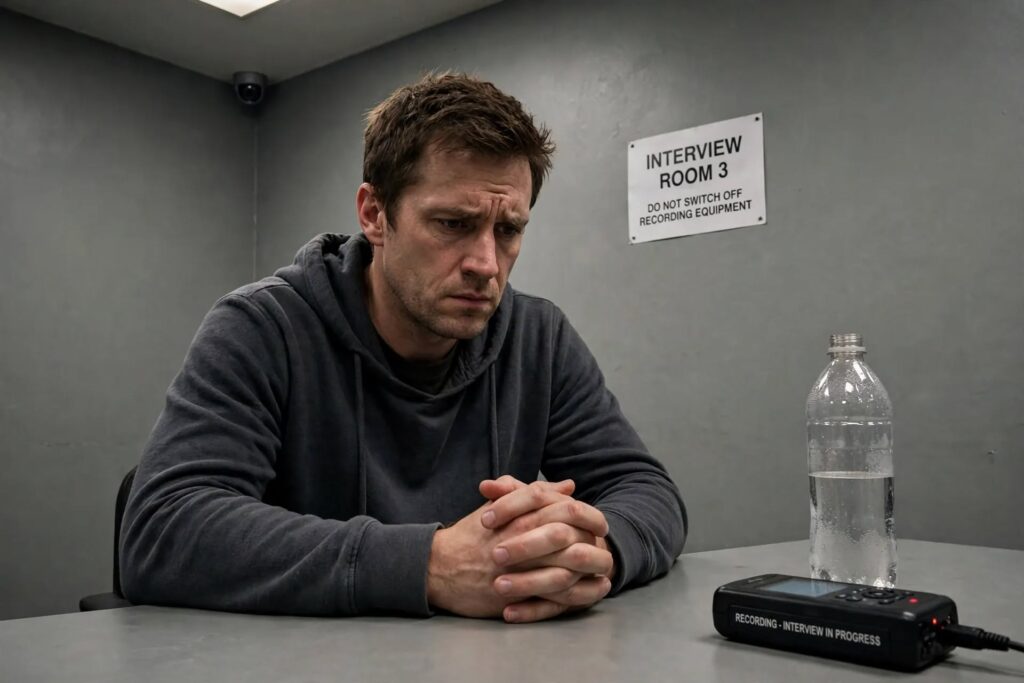
A suspect is asked whether they can be absolutely certain that forensic testing will not identify their DNA on an alleged victim. The suspect pauses, lowers their head and eventually answers, “No.”
That answer might be entirely consistent with uncertainty about the limits of forensic testing. It does not, by itself, establish guilt or dishonesty.
However, the prosecution may seek to rely on the answer and the surrounding circumstances to challenge the suspect’s account, depending on the evidence.
This example illustrates why answering questions without understanding their significance can be risky. A seemingly straightforward question may have a purpose that is not immediately apparent to the person being interviewed.
It is important, however, not to overstate the significance of body language. A pause, lowered head or nervous manner does not establish guilt. People react differently under pressure, and a jury must assess the evidence as a whole.
The real concern is that an interview may create a permanent record of your answers, including any ambiguity or inconsistency that could later require explanation.
4. What If You Are Innocent?
One of the most common misconceptions is that an innocent person has nothing to lose by answering police questions.
That is not necessarily true.
You may be innocent but unable to recall every detail accurately. You may misunderstand a question, agree with a proposition without appreciating its implications, or make an assumption that later proves incorrect.
You might also provide an explanation that appears inconsistent with evidence obtained after the interview.
None of these circumstances automatically means that you are guilty. However, they can complicate your defence and create issues that would not otherwise have arisen.
The decision about whether to participate should therefore not be based solely on your confidence in your innocence.
Instead, you should consider what the police are investigating, what evidence they may already have, what you would be able to say accurately, and whether the potential benefits of answering questions outweigh the risks.
5. What Are Your Rights If Police Want to Interview You in Queensland?
Your legal position will depend on the circumstances, including whether you have been arrested, whether you are in custody, the nature of the alleged offence and the applicable legislation.
In Queensland, a person who is suspected of an offence generally has important protections concerning self-incrimination and the right to silence, subject to statutory exceptions and specific legal requirements.
You should not assume that you must answer every question merely because police have arrested you or asked you to attend an interview.
Equally, you should not assume that remaining silent will always be without consequences. The legal implications of silence can depend on the circumstances, the particular offence and the applicable law.
If police ask you to participate in an interview, you should seek legal advice before answering substantive questions. A defence lawyer can explain your rights, identify any relevant exceptions and advise you on the potential consequences of participating or declining.
If you are in custody, ask to speak to a lawyer before deciding whether to take part in an interview.
6. Why You Should Discuss the Entire Case With Your Defence Lawyer First
Deciding whether to participate in a police interview should involve much more than a brief conversation about whether you are innocent.
Your defence lawyer needs to understand the complete circumstances of the allegation before providing meaningful advice.
This includes information such as:
What happened before, during and after the alleged offence.
What the complainant has alleged.
Whether there are independent witnesses, CCTV footage, messages or forensic evidence.
What you have already told police or other people about the incident.
Whether there are inconsistencies between your account and other available evidence.
Whether a potential defence arises from the circumstances.
Whether an interview could expose you to additional risks or assist in clarifying a significant issue.
You should be completely frank with your lawyer, including about facts that you believe may be unfavourable to your case. Your lawyer needs to understand the full picture to assess the risks and provide appropriate advice.
In my practice, I consider not only the client’s account of the incident but also the surrounding circumstances, the available evidence and the client’s ability to explain events accurately under pressure.
The objective is not to prepare a misleading account or to coach someone to give a particular answer. It is to assess the legal position, identify potential risks and make an informed decision about the best course of action.
There is no substitute for a detailed, confidential discussion with your criminal defence lawyer before participating in a police interview.
7. Should You Give a Police Interview? The Answer Depends on Your Case
There is no universal answer.
In many cases, the risks of participating in a police interview may outweigh the potential benefits. In others, a carefully considered interview may provide an opportunity to put important information before investigators.
What matters is that the decision is made after considering the specific allegations, the available evidence, your potential defences and the consequences of each available option.
Do not assume that cooperating with police requires you to answer every question. Do not assume that an interview will cause the charges to be withdrawn. And do not make the decision simply because you believe that an innocent person should have nothing to hide.
If you have been arrested, charged or invited to participate in a police interview, obtain legal advice before deciding how to proceed.
Need Advice Before a Police Interview?
If Queensland Police have asked you to participate in an interview, or you have been arrested in connection with an alleged offence, I encourage you to obtain advice as early as possible.
I am A. J. Faisal, a solicitor at Sterling Law. I assist clients facing criminal allegations and understand the importance of making informed decisions at the early stages of a criminal investigation.
I offer an obligation-free initial telephone consultation to discuss your circumstances and explain how I may be able to assist. An in-person consultation can also be arranged where appropriate.
Every case is different. I will consider the information you provide and help you understand the potential advantages, risks and legal implications of participating in a police interview.
Contact AJ Faisal on 07 3103 044 before answering police questions. Early legal advice can make a significant difference to how you approach your case.