22 October 2026
Criminal Charges Withdrawn or Dismissed? | Brisbane Criminal Lawyer
Disclaimer
This is an AI-generated blog providing basic general information only. It is not legal advice and does not constitute advice from a lawyer. For advice about your particular circumstances, please contact a qualified criminal lawyer. You are also welcome to call AJ Faisal by hitting the call now button for a free initial consultation to discuss your situation.
Have you been charged with a criminal offence in Brisbane and want to know whether the charges can be withdrawn or dismissed? The answer is yes. In some circumstances, criminal charges can be withdrawn by the prosecution or dismissed by a court. However, the outcome depends on the evidence, the applicable law and the circumstances of your case.
If you are facing criminal charges, speaking with an experienced Criminal Lawyer in Brisbane as early as possible can help you understand your options and determine whether there are grounds to challenge the prosecution case.
At Sterling Law, we assist clients facing criminal charges and can assess whether there may be a basis to seek the withdrawal of charges or defend the matter in court.
1. Can the police or prosecution withdraw criminal charges?
Yes. Criminal charges may be withdrawn or discontinued where the prosecution determines that continuing the case is not appropriate.
For example, this may occur where:
There is insufficient evidence to prove the alleged offence.
Witness evidence is unreliable, inconsistent or has changed.
New evidence becomes available that undermines the allegations.
The available evidence does not establish an essential element of the alleged offence.
There are legal problems with the prosecution case.
The prosecution determines that continuing the proceedings is not in the public interest.
The decision-making process depends on the stage of the proceedings and the type of offence. Police prosecutors and the Office of the Director of Public Prosecutions (ODPP) have different roles in Queensland criminal proceedings.
A defence lawyer may review the evidence, identify weaknesses in the case and make representations to the prosecution requesting that one or more charges be withdrawn.
However, making representations does not guarantee that the prosecution will agree to withdraw the charges.
2. What is the difference between withdrawn and dismissed charges?
Although the terms are sometimes used interchangeably, withdrawing a charge and having a charge dismissed are not necessarily the same thing.
Withdrawn charges
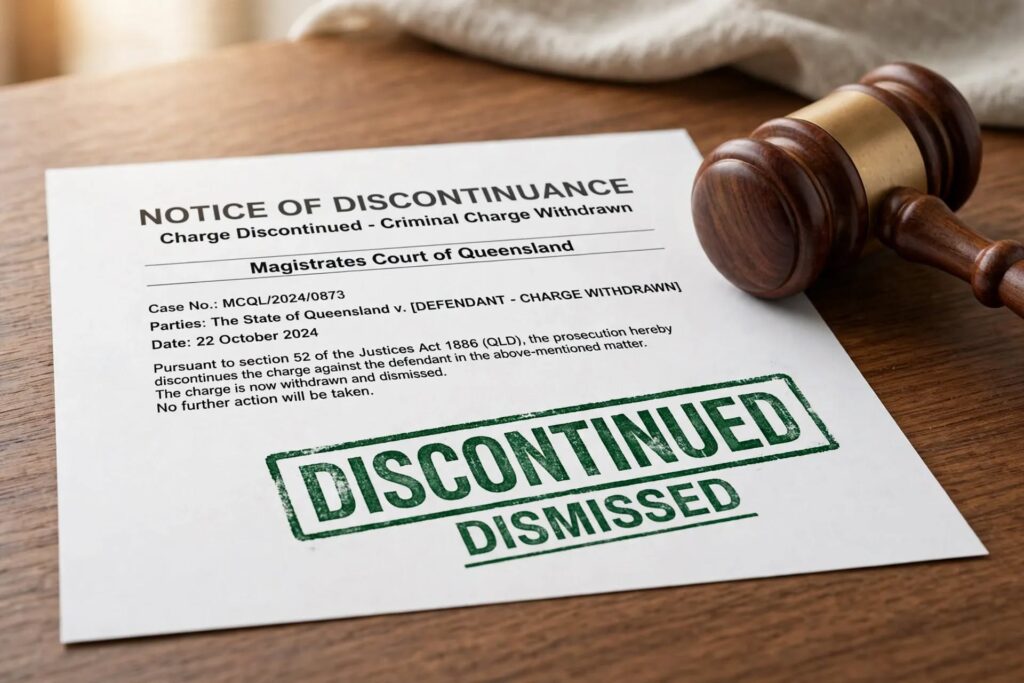
A charge may be withdrawn when the prosecution decides not to proceed with it. Depending on the circumstances, the proceedings may be discontinued without a trial.
Dismissed charges
A charge may be dismissed by a court following a legal or evidentiary determination. For example, after hearing the evidence in a summary trial, a magistrate may find that the prosecution has not proved the charge beyond reasonable doubt.
In some committal proceedings, a magistrate may also determine that the evidence is insufficient to send an indictable matter to trial.
The legal consequences of a withdrawal, discharge, dismissal or discontinuance can differ. In particular, a withdrawn or discontinued charge does not invariably prevent further proceedings in every circumstance.
A Criminal Lawyer in Brisbane can explain which outcome may be available in your case and what it means for your criminal proceedings.
3. Can criminal charges be withdrawn before the first court date?
In some cases, yes.
If the evidence reveals a significant problem with the allegations, your lawyer may be able to raise that issue with the prosecution before the matter progresses further.
For example, the evidence may show that:
You have been incorrectly identified as the alleged offender.
Important witness statements contradict the allegation.
CCTV footage or other records do not support the police version of events.
The alleged conduct does not satisfy the legal elements of the offence charged.
There is a substantial gap in the available evidence.
Early legal advice can help identify these issues and determine whether representations should be made to the prosecution.
However, the fact that you dispute the allegation does not automatically mean the charges will be withdrawn. The prosecution will consider the available evidence and applicable legal requirements before making its decision.
4. What if the evidence against me is weak?
Weak evidence may provide grounds to challenge a criminal charge, but the strength of the case must be assessed as a whole.
For example, a prosecution case may depend heavily on the reliability of a witness, the interpretation of a recording, forensic evidence or statements allegedly made by the accused.
Your lawyer may examine whether the evidence is admissible, whether it is reliable and whether it proves each element of the alleged offence.
Depending on the circumstances, the appropriate strategy may be to:
Request further disclosure from the prosecution.
Identify inconsistencies in witness statements.
Challenge the admissibility or reliability of particular evidence.
Make written representations seeking withdrawal of the charge.
Negotiate an appropriate resolution where legally and factually justified.
Prepare to contest the charge at a hearing or trial.
It is important to distinguish between evidence that is merely disputed and evidence that creates a genuine legal or evidentiary difficulty for the prosecution.
The prosecution must prove the charge to the required criminal standard. You do not have to prove your innocence simply because you have been charged.
5. Can a criminal lawyer negotiate with the prosecution to withdraw charges?
Yes. Depending on the circumstances, a criminal defence lawyer may communicate with the prosecution and make submissions explaining why charges should be withdrawn, amended or otherwise resolved.
This process may involve reviewing the police brief, identifying deficiencies in the evidence, providing relevant material and explaining the legal issues arising from the allegations.
In some cases, a lawyer may seek the withdrawal of all charges. In others, the appropriate outcome may be the withdrawal of particular charges while other charges remain.
There may also be circumstances in which the prosecution is prepared to consider an amended charge or an agreed resolution. Whether this is appropriate depends on the facts, the available evidence and the applicable law.
A lawyer should provide a realistic assessment of the prospects of success rather than promise that charges will be withdrawn.
6. What should I do if I have been charged with a criminal offence?
If you have been charged, there are several practical steps you can take to protect your position.
First, obtain legal advice promptly. Avoid making assumptions about the strength of the case before the evidence has been reviewed.
Second, preserve relevant evidence. This may include messages, emails, photographs, CCTV footage, receipts or other records that could be relevant to the allegations. Do not delete or alter potentially relevant material.
Third, be careful when discussing the allegations. Statements made to police, witnesses or other people may become relevant to the proceedings. Obtain legal advice before participating in a police interview or making further statements about the incident.
Fourth, comply with your court and bail obligations. If you have been given a court date or released on bail, make sure you understand and comply with the applicable requirements.
Finally, obtain a copy of the available police court brief and have it reviewed by your lawyer. In Queensland, this is commonly referred to as the QP9, although the material available may depend on the stage of the proceedings.
7. How can I find a criminal lawyer near me?
If you have been charged with an offence, searching for a criminal lawyer near me may help you find legal assistance in your area. However, it is important to consider more than location alone.
Look for a lawyer who can explain the allegations, review the available evidence, advise you about your options and develop a strategy appropriate to your circumstances.
If your matter is in Brisbane or elsewhere in Queensland, a lawyer familiar with Queensland criminal procedure can advise you about the relevant court process and the available options for resolving or contesting the charges.
At Sterling Law, we can discuss your circumstances, explain the legal process and assess whether there may be grounds to seek the withdrawal or dismissal of your charges.
8. Can I guarantee that my charges will be withdrawn?
No responsible lawyer can guarantee that criminal charges will be withdrawn or dismissed.
Even where there are apparent weaknesses in the prosecution case, the final outcome depends on the evidence, the relevant law, the prosecution’s assessment and, where the matter proceeds to court, the court’s determination.
The purpose of obtaining legal advice is to understand your position, identify any available legal arguments and take appropriate steps to protect your interests.
Early advice may also help you avoid making decisions that could unnecessarily complicate your case.
Speak to a Criminal Lawyer in Brisbane
If you have been charged with a criminal offence, you may be worried about the consequences for your employment, family, reputation or future.
You do not have to navigate the criminal justice process without legal advice.
We can assess the circumstances of your case, review the available evidence and advise you whether there may be grounds to seek the withdrawal of charges or defend the allegations in court.
If you are searching for a Criminal Lawyer in Brisbane or a criminal lawyer near me, contact now to discuss your situation and your available options.
Contact Sterling Law to arrange an obligation-free telephone consultation. An initial discussion can help you understand the next steps and whether further legal advice is appropriate.
General information only: This article provides general information about criminal proceedings in Queensland and is not legal advice. The appropriate strategy will depend on the facts and circumstances of each case.