8 November 2026
Shoplifting Lawyer in Brisbane: Charges, Penalties and Defence
Charged with shoplifting, stealing or card fraud in Brisbane? Learn how Queensland charges work, what penalties apply and how a defence lawyer can help.

Disclaimer
This is an AI-generated blog providing basic general information only. It is not legal advice and does not constitute advice from a lawyer. For advice about your particular circumstances, please contact a qualified criminal lawyer. You are also welcome to call AJ Faisal by hitting the call now button for a free initial consultation to discuss your situation.
A shoplifting charge in Queensland can be a minor fine or a stealing charge that carries up to five years in prison. The outcome depends largely on the value of the goods, the evidence of dishonesty and how the case is handled from the first court date. A shoplifting lawyer reviews the police allegations, advises on the available defences and appears for you in the Magistrates Court. This guide explains how the charges are classified, what penalties apply, and how related allegations such as identity theft and credit card fraud are treated.
TL;DR
- In Queensland, shop goods worth $150 or less are usually dealt with as a regulatory offence with a fine. Above $150, police can charge stealing, which has a maximum of 5 years in prison.
- A conviction for even a low-value offence can form part of your criminal history, although you can ask the court not to record it.
- Dishonesty is central to most shoplifting, stealing and fraud charges, and the prosecution’s version of events (the QP9) is the first document to obtain.
- Missing a court date can lead to a warrant and a further charge, so act before your first appearance.
- AJ Faisal offers a free case review and a free initial consultation for people charged in Brisbane.
Table of Contents
- How shoplifting is charged in Queensland
- What can lead to identity theft, credit card fraud or identity fraud charges
- Penalties and consequences
- The court process from charge to trial
- Defences and evidence in a shoplifting or fraud case
- What a shoplifting lawyer does
- Our perspective
- Speak to AJ Faisal about your charge
- FAQ
- Sources
How shoplifting is charged in Queensland
Queensland does not have a single offence called shoplifting. Police choose between two categories, and the choice is driven mainly by the value of the goods.
Goods worth $150 or less: a regulatory offence
Where shop goods are worth less than $150, the conduct is a regulatory offence under the Regulatory Offences Act 1985, with a fine of 6 penalty units ($1,036.20). The Queensland Law Handbook describes the conduct covered, which includes consuming goods without consent, altering or removing price details, and taking goods without paying.
The court can also order costs of investigation, costs of court and compensation to the store, as the same handbook page explains under section 9 of the Act.
Goods worth more than $150: stealing
When the value is over $150, police can charge the more serious offence of stealing, which has a maximum penalty of 5 years in prison. The Queensland Law Handbook notes that the head sentence is generally five years under section 398, rising to as much as 10 years in aggravated circumstances, such as stealing from a dwelling above set value thresholds or from a vehicle.
The same guidance says stealing is an indictable offence that must generally be dealt with summarily in the Magistrates Court. Limited exceptions apply where value thresholds are exceeded, including property worth more than $30,000. In practice, most retail stealing matters in Brisbane are finalised in the Magistrates Court.
Why the $150 line matters
The difference between the two categories is not only the size of the penalty. It affects how the charge is described on your record, how an employer or licensing body may view it, and which defences are open to you. Where the value is close to $150, the evidence about price, quantity and what was actually taken can change the charge itself. This is one of the first things we check on a case review.
What can lead to identity theft, credit card fraud or identity fraud charges
People who search for a shoplifting lawyer often face a wider allegation, because the same incident can involve a card or false details. The conduct that attracts these charges generally centres on deception and dishonesty.
The Australian Bureau of Statistics classification of obtaining benefit by deception treats identity theft as fraudulently using a person’s identity, or parts of it, for personal gain. It includes credit card and debit card fraud.
The Queensland Police Service describes fraud as deceptive or dishonest behaviour and lists examples such as stealing someone’s identity, creating fake identities and credit card or EFTPOS card fraud.
In legal terms, fraud under section 408C of the Criminal Code requires dishonesty, as the Queensland Law Handbook explains. That requirement is often the real battleground in a defended case.
Common situations
- Using a card at a self-serve checkout and not scanning every item.
- Using a card you believed you were entitled to use, which later turns out to be unauthorised.
- Giving a false name or someone else’s details to a retailer or financial provider.
- Leaving a restaurant or hotel without paying a bill. Under section 6 of the Regulatory Offences Act, the penalty can be a fine of $300, and specific defences apply where you reasonably believed payment would be made or the card was authorised.
If you are the person whose card or identity was misused, speed matters. Legal Aid Queensland explains that under the ePayments Code, notifying your bank within a reasonable time helps limit your exposure unless you are partly responsible, for example through a compromised PIN.
Penalties and consequences
Queensland courts have a wide range of options. Legal Aid Queensland lists a fine, restitution, a good behaviour bond, probation, community service, an intensive corrections order, a suspended sentence or jail. Which one applies depends on the charge, your history, the value, and the circumstances of the offence and of you.
| Charge | Typical exposure in Queensland | What else can follow |
|---|---|---|
| Regulatory offence, shop goods $150 or less | Fine, 6 penalty units ($1,036.20) | Costs and compensation; criminal history entry unless the court orders no conviction be recorded |
| Stealing, goods over $150 | Maximum 5 years in prison | Fine, bond, probation, community service or custodial options |
| Aggravated stealing | Up to 10 years in specified circumstances | Higher risk of a custodial sentence |
| Leaving a restaurant or hotel without paying | Fine of $300 | Costs or compensation |
Criminal history and recorded convictions
Legal Aid Queensland states that a conviction for a regulatory offence involving shop goods of $150 or less becomes part of your criminal history, although you can ask for the conviction not to be recorded. That request is a submission the court considers, so it needs to be prepared properly, with material on your employment, study, character and the circumstances.
Probation
A probation order can run from 6 months to 3 years and carries reporting and behavioural conditions. A breach can lead to a charge of breach of probation, cancellation of the order and a return to court for the original offence.
Unpaid fines
If a fine goes unpaid, the State Penalties Enforcement Registry (SPER) can act. According to the same Legal Aid Queensland guide, this can mean suspending a driver licence, directing bank transfers or employer deductions, seizing and selling property, or issuing an arrest warrant, and an enforcement fee may be added. For details on how a custodial outcome is assessed, see our article Will I Go to Jail? Brisbane Criminal Lawyer Explains.
The court process from charge to trial
Your first court date
Your bail undertaking, notice to appear, or complaint and summons will state a court date. This date is not optional. Legal Aid Queensland warns that if you do not attend, the court can issue a warrant and you may face a further offence of failing to appear, which can include imprisonment.
The Magistrates Court practice direction sets the timing. If you are arrested and not released on bail, the first appearance is that day or the next sitting day. Otherwise, the first appearance is at least 14 days after arrest or service of the notice, unless you agree to a shorter time.
Readers who compare overseas systems may notice that some US states, such as Minnesota, rely on theft bail bond arrangements to secure release. In Queensland, release is by bail undertaking set by police or a court, and our guides on bail applications in Brisbane cover the tests applied.
Callover and trial
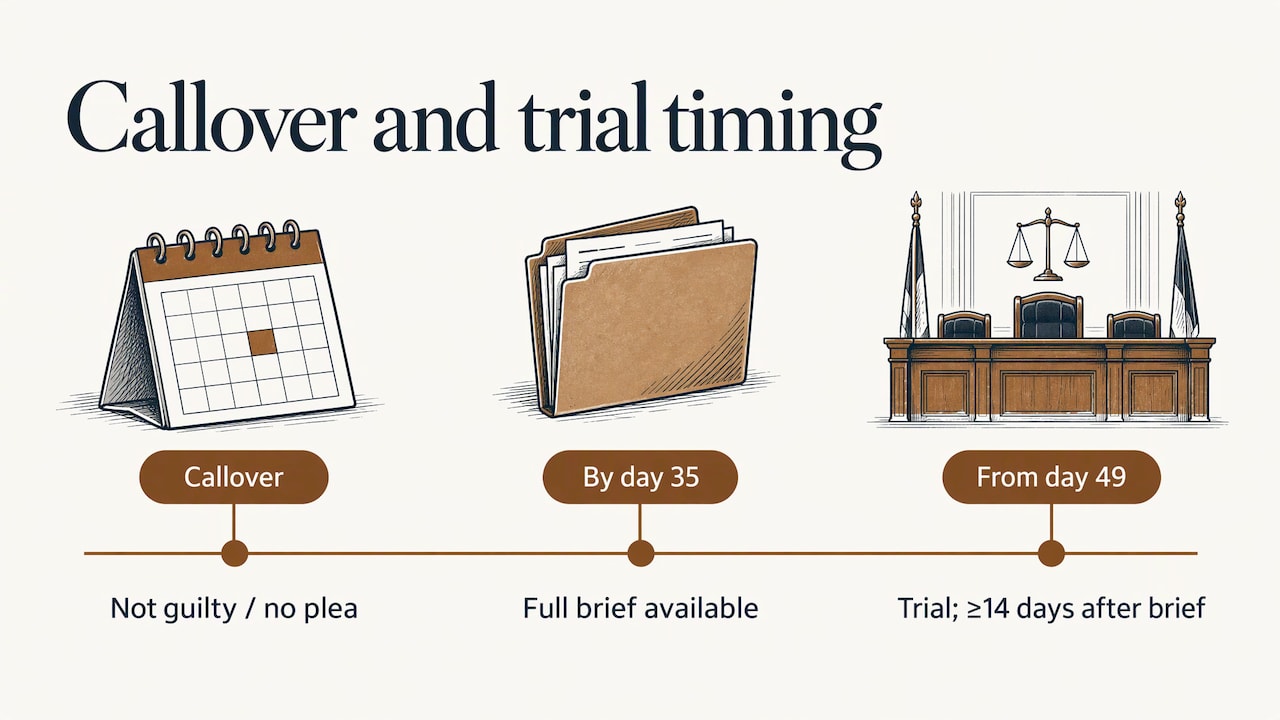
If you plead not guilty or enter no plea at the Summary Callover, the practice direction provides that the trial is set for hearing no earlier than 49 days later. The full brief of evidence must be available for collection within 35 days and at least 14 days before the trial.
Committals
For other indictable offences, the magistrate sets a committal hearing to decide whether there is enough evidence to send the defendant to trial. The prosecutor presents the case, the defence can cross-examine witnesses, and if the evidence is not enough the case is dismissed.
Defences and evidence in a shoplifting or fraud case
Every case turns on its own facts, but several issues recur.
- Dishonesty. For non-payment under the regulatory provisions, a defence is to prove the taking was not dishonest. Defences under sections 5 and 6 must be proved on the balance of probabilities.
- Intention. For stealing, the prosecution must prove a fraudulent intention of a specified kind, as well as the taking or converting of the property.
- Belief about authority. For card-related allegations, the section 6 defences consider whether you believed on reasonable grounds that payment would be made or that the card was authorised.
- Value. The value of the goods decides which category the charge falls into, so receipts, price tags and stock records can be significant.
- Identification and footage. CCTV quality, the timing of any store detention and what was said to security staff can all affect the weight of the evidence.
- Police interview. What you said to police may be relied on at trial. Read Should I participate in a police interview? and Police Interview in Queensland: What Does It Mean? before you speak to police.
Get the QP9 early
Legal Aid Queensland advises that if you are charged you should ask police prosecutions for the QP9, a written summary of the police version of why you were charged and what happened. You can request it on the first court date, or later by written application with photo ID. It gives your lawyer a starting point for advising on plea, evidence and prospects.
What a shoplifting lawyer does
A defence lawyer’s work starts before court and often decides the result before the hearing. In a retail theft or card fraud matter, that work usually includes:
- Reading the QP9 and any brief of evidence, and identifying gaps.
- Advising honestly on whether to plead guilty or contest the charge.
- Making submissions on the value and category of the charge.
- Preparing material for sentencing, such as references, proof of employment or study, and evidence of treatment or counselling where relevant.
- Applying for a non-recorded conviction where the law allows it.
- Appearing at the first mention, callover, and any trial or sentence.
A free duty lawyer may be available at most Magistrates Courts on the court date. Legal Aid Queensland says the service helps with less complex guilty pleas, adjournments, bail applications and bail-condition changes, but only on that date. For preparation across the whole matter, it points to applying for legal aid or engaging a private lawyer. In the Brisbane region, duty lawyer services are provided by Legal Aid Queensland’s in-house criminal lawyers and private lawyers.
For a broader picture of how representation works, see Facing Criminal Charges in Brisbane? How an Experienced Criminal Lawyer Can Help. If the allegation is later withdrawn, our article on charges withdrawn or dismissed explains how that happens.
Our perspective
Most people who contact us about a shopping or card allegation have never been in court. They tend to assume that a low-value charge is not worth defending, or that a serious one is already lost. Neither assumption is safe.
Our approach is to give an honest assessment first. We read the police version, identify what the prosecution must prove, and tell you plainly where the case is strong and where it is not. We do not promise outcomes we cannot control.
Once the position is clear, we build the defence around you: contesting dishonesty where the evidence supports it, challenging value and identification, or preparing the strongest possible submissions on penalty and on whether a conviction is recorded. AJ Faisal has handled over 1,000 criminal cases across the Brisbane courts, and the aim in each one is the best result the facts allow.
We offer a free case review and a free initial consultation, and our service is fixed fee, so you know the cost of the work before it starts.
A
Speak to AJ Faisal about your charge
If you have been charged with shoplifting, stealing, credit card fraud or identity fraud in Brisbane, the most useful step is to have the allegation assessed before your first court date. AJ Faisal offers a free case review and a free initial consultation, covering theft, fraud and related charges in the Brisbane courts. Contact AJ Faisal through the Brisbane criminal lawyer page to arrange a time.

Bring your court papers, any notice to appear and anything the store or police gave you. If you have fees questions, our article on how law firms charge legal fees explains costs and trust accounts.
FAQ
Can a shoplifting charge be dealt with without going to jail?
Yes, in many cases. For shop goods of $150 or less, the offence is regulatory and the penalty is a fine. For stealing, courts can also order a bond, probation, community service or other non-custodial sentences, although the maximum is 5 years. The outcome depends on the facts and your history.
Will a shoplifting conviction appear on my criminal history?
It can. Legal Aid Queensland states that a regulatory offence conviction forms part of your criminal history, but you can ask the court not to record the conviction. A lawyer can prepare that request with supporting material.
Do I need to go to court if I paid the store or returned the goods?
Yes. Paying the store or returning the items does not cancel the police charge. If you do not attend the date on your notice, the court can issue a warrant and you may face a further charge of failing to appear.
What is a QP9 and why does it matter?
The QP9 is a written summary of the police version of why you were charged and what happened. You can ask police prosecutions for it on your first court date. It lets your lawyer see the allegation in detail before advising you on plea.
Is using someone else’s card the same as shoplifting?
No. Card misuse is generally treated as fraud or identity-related dishonesty, not as taking goods. Fraud requires dishonesty, and defences may apply if you reasonably believed the card was authorised. The two allegations can arise from the same incident and are often assessed together.
Sources
- Shoplifting, stealing, fraud and burglary, Queensland Government
- Stealing, Queensland Law Handbook Online
- Dishonesty Offences, Queensland Law Handbook (PDF)
- Obtain benefit by deception, Australian Bureau of Statistics
- Fraud, Queensland Police Service
- Identity theft, Legal Aid Queensland
- Possible penalties and sentences, Legal Aid Queensland
- Shoplifting, not paying and property damage, Legal Aid Queensland
- Being charged with an offence, Legal Aid Queensland
- Criminal law duty lawyer, Legal Aid Queensland
- Areas of expertise, Legal Aid Queensland
- What happens at the Magistrates Court, Queensland Courts
- Magistrates Courts practice direction (PDF), Queensland Courts
- Theft bail bonds, Minnesota