7 November 2026
Traffic Lawyer in Brisbane: Charges, Licences and Court
What a Brisbane traffic lawyer does, the 28-day deadline for fines, licence loss, court costs and how to act early. Free consultation with AJ Faisal.
Disclaimer
This is an AI-generated blog providing basic general information only. It is not legal advice and does not constitute advice from a lawyer. For advice about your particular circumstances, please contact a qualified criminal lawyer. You are also welcome to call AJ Faisal by hitting the call now button for a free initial consultation to discuss your situation.
A traffic lawyer in Brisbane advises and represents people who have been charged with a driving offence or fined, and who face a court date, demerit points or the loss of their licence. The earlier you obtain advice, the more options remain open, because several important decisions in Queensland carry strict deadlines and some cannot be undone. AJ Faisal is a Brisbane criminal lawyer who appears in the Brisbane courts and handles traffic matters, with a free initial consultation and a free case review.
This guide explains what a traffic lawyer actually does, what to do in the days after a notice or charge, how penalties and licence consequences work, what happens in the Magistrates Court and how costs should be assessed.
TL;DR
- If you receive an infringement notice and wish to dispute it, you generally have 28 days to do so. Do not pay the fine if you intend to contest it.
- Electing to go to court cannot be reversed, so obtain legal advice before you make that election.
- Traffic penalties can include a fine, demerit points, disqualification, a probation order or jail, depending on the offence and your history.
- A lawyer can assess the evidence, your traffic history, licence options and the realistic outcomes before you commit to a course of action.
- AJ Faisal offers a free initial consultation and fixed fee service for traffic matters in Brisbane.
Table of Contents
- What a traffic lawyer handles in Brisbane
- What to do after a fine or charge
- Penalties for traffic offences in Queensland
- How a traffic offence affects your licence
- What happens in court in Brisbane
- Costs to understand before you decide
- Our perspective on traffic matters
- Free case review with AJ Faisal
- Choosing a traffic lawyer in Brisbane
- FAQ
- Sources
What a traffic lawyer handles in Brisbane
Traffic law sits across a wide range. At the lower end is a fine for speeding or a similar infringement. At the upper end are charges that proceed in court and may lead to disqualification or imprisonment. A traffic lawyer deals with the following kinds of matters:
- Disputing an infringement notice, including preparing the election to have the matter decided in court.
- Court appearances in the Magistrates Court, including pleas, submissions on penalty and contested hearings.
- Licence consequences, such as disqualification, suspension for demerit points, and applications for a special hardship order.
- Serious driving charges, including driving while disqualified, where the penalties are heavier.
- Challenges to evidence, such as the accuracy or use of a speed detection device.
Legal Aid Queensland advises that anyone charged with a traffic offence should get legal advice. The reason is practical: the right approach depends on the offence, the circumstances and your traffic history, and these are matters a lawyer can weigh against each other before you act.
AJ Faisal lists traffic matters among the criminal charges he defends, alongside assault, drug, fraud, theft and white collar matters. That breadth is relevant, because a driving charge can sometimes sit alongside other allegations arising from the same incident, and a single lawyer can then manage both.
What to do after a fine or charge
The first steps are procedural, and they matter more than most people expect.
- Read the notice carefully. It states the offence, the amount and the deadline for your response. Keep the original and a copy.
- Do not pay a fine you intend to dispute. The Queensland Government advises that you must dispute a fine within 28 days of the date of the infringement notice or you will face penalties for an overdue fine, and that you should not pay it and should keep a copy for your records.
- Identify the correct form. To dispute an infringement, you submit the Election for Court section of the notice or Form F5111, according to Legal Aid Queensland. Check the notice for the deadline that applies to you.
- Obtain advice before you elect. This is the step people skip.
- Collect your records. Photographs of the location, signage, dashcam footage, work rosters and any correspondence can all become relevant.
Why the election to go to court needs advice first
The Queensland Law Handbook notes that the election to go to court to dispute an infringement notice cannot be reversed. It also notes that a person who is convicted must pay the offender levy in addition to any fine. Once you elect, the matter is in the hands of the court, so the decision should rest on an honest assessment of the evidence rather than on frustration with the fine.
That is the approach we take at AJ Faisal: an honest assessment first, then a strategy. If the prospects are strong, we say so. If a different path is more sensible, you will hear that before you commit.
What happens if a fine goes unpaid
Ignoring a fine is the worst option. Legal Aid Queensland states that the State Penalties Enforcement Registry (SPER) can suspend your driver licence, direct your bank to transfer funds, direct your employer to deduct wages, register an interest over your property, immobilise your vehicle, seize and sell your property, or issue a warrant for your arrest and imprisonment if a fine is not paid on time. A small matter that is left alone can therefore grow into a much larger one.
Penalties for traffic offences in Queensland
Penalties vary with the offence. According to Legal Aid Queensland, they can range from a fine, demerit points and disqualification to a probation order or jail, depending on the offence, the circumstances and your traffic history.
Many traffic offences express their maximum penalty in penalty units. The Queensland Law Handbook states that as at May 2026 the penalty unit is $166.90. A maximum of, say, 20 penalty units therefore converts into a dollar figure that changes when the unit is indexed, so always check the current value rather than relying on an old figure.
Three factors usually shape the outcome:
- The offence itself. Its seriousness and the maximum penalty set the range.
- The circumstances. Speed, conditions, whether anyone was endangered and your conduct afterwards can all matter.
- Your traffic history. Previous offences and demerit points often influence what the court considers appropriate.
A lawyer prepares each of these. For a plea of guilty, that means presenting your circumstances, references and any steps you have taken, so the court has a full picture before it decides the penalty.
How a traffic offence affects your licence
For many Brisbane drivers, the licence matters more than the fine. People rely on it to get to work, to drive for a living or to care for family, which is why licence consequences deserve particular attention.
Disqualification
Legal Aid Queensland notes that traffic penalties can include disqualification. The Queensland Government explains that if you are convicted of two or more offences with separate disqualification periods, you serve each period one after the other, not all at once, and that after serving a period you can apply to have your licence re-issued as a probationary licence held for at least one year.
Driving while disqualified is treated seriously. If convicted, the court must disqualify the driver for a further 2 to 5 years, and the driver may also receive a fine or imprisonment for up to 18 months.
Demerit points and good behaviour licences
Legal Aid Queensland explains that if you accumulate too many demerit points, you will usually receive a letter from the Department of Transport and Main Roads. It gives you the choice of a suspension for several months or a good behaviour licence for a year, during which two or more further demerit points result in suspension. For a high speed offence of 40 km/h or more over the limit, the licence is suspended immediately for six months with no good behaviour option.
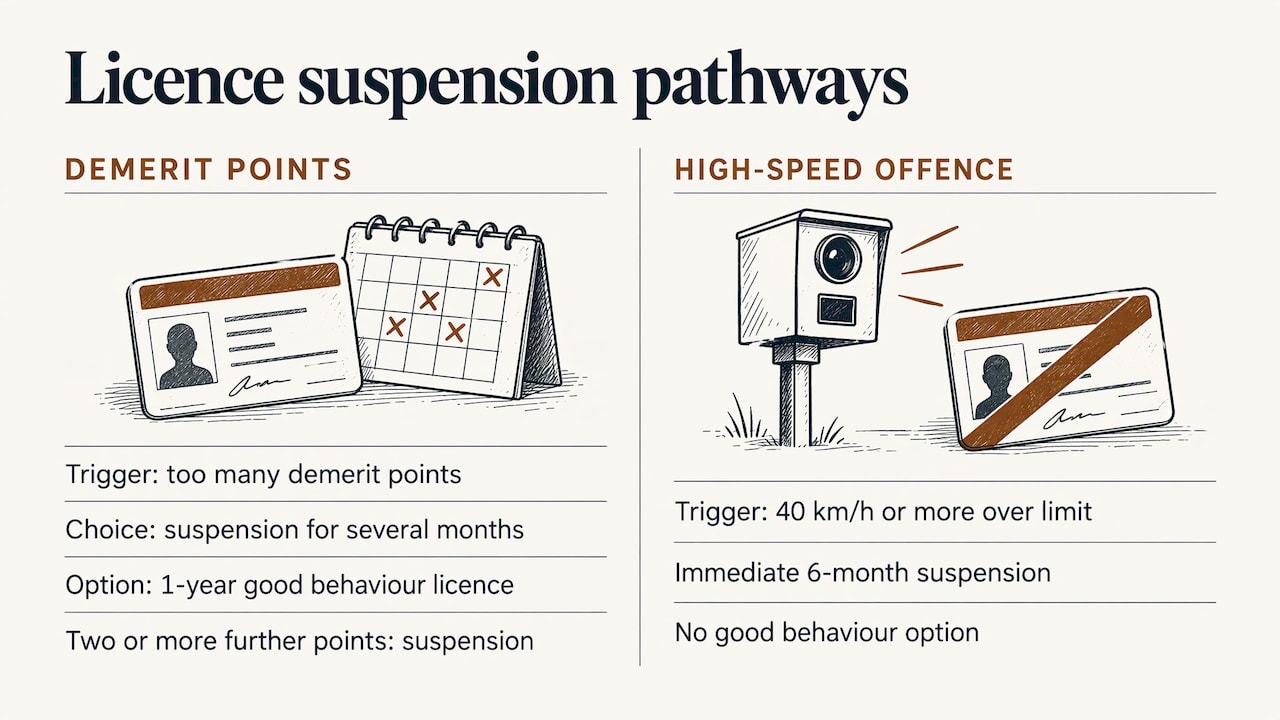
The choice deadline on the notice matters. Read it the day it arrives and seek advice about which option suits your work and family commitments.
Special hardship orders
In limited circumstances you may be able to apply for a special hardship order, which Legal Aid Queensland describes as one of the matters a lawyer can advise on. Eligibility is narrow and depends on how the suspension arose, so the application needs to be prepared with evidence of the hardship a suspension would cause. A lawyer can tell you at the start whether you are likely to qualify and what material the court will want to see.
What happens in court in Brisbane
If you are 17 or older and charged with a criminal offence or some traffic offences, you appear in the Magistrates Court. Legal Aid Queensland states that a single magistrate hears these cases, with no jury.
There are two common paths:
| Path | What it involves | What a lawyer does |
|---|---|---|
| Plea of guilty | The court decides the penalty, considering your history and circumstances | Prepares submissions, references and material on licence impact |
| Contested hearing | The prosecution must prove the charge, and your side can test the evidence | Reviews the evidence, prepares cross-examination and legal argument |
A matter can also be resolved before a hearing if the prosecution withdraws or amends the charge. Our blog explains what happens when criminal charges are withdrawn or dismissed.
Challenging a speed detection device
Some speeding matters turn on the accuracy or use of the device. The Queensland Law Handbook states that a person who disputes a device’s accuracy must serve the prosecution with a signed notice of the grounds at least 14 days before the hearing. It also warns that, if the person is found guilty, the court is likely to order payment of expert witness expenses that can amount to several thousand dollars.
This is exactly the kind of decision that benefits from advice. The challenge can be worthwhile where the evidence supports it, and the cost exposure needs to be understood before the notice is served.
Costs to understand before you decide
Two kinds of cost arise: the cost of your lawyer and the costs the court can impose.
Court costs. Legal Aid Queensland states that the offender levy is $142.80 in the Magistrates Court, and $428.00 in the District Court and the Supreme Court. It applies whether or not a conviction is recorded. If you are found guilty after contesting a traffic fine, you pay the levy on top of any fine, summons cost or witness expenses. If you contest successfully and are found not guilty, you do not pay the levy.
Legal fees. AJ Faisal provides a fixed fee service, so you know the cost of the work before it starts. We do not publish prices on our site, as each matter differs. The free initial consultation is the place to obtain a figure for your own case. Our guide to how law firms charge legal fees explains billing, trust accounts and what a written estimate should cover.
Whatever firm you consider, a clear estimate should state:
- what work is included, such as advice, preparation and appearances
- whether the fee is fixed or hourly
- what is not included, such as expert or witness costs
- what happens if the matter changes, for example if it proceeds to a hearing
Our perspective on traffic matters
Traffic charges are often treated as minor. In our experience that is the mistake that costs people the most. A licence supports a job, a family and a routine, and a conviction or disqualification can affect all three for a long time.
We approach a traffic matter the way we approach any criminal charge. We read the brief, assess the evidence and tell you honestly where you stand. If there is a defence, we pursue it firmly. If the better course is a plea, we prepare it thoroughly so the court sees the whole person and not only the charge sheet.
We do not make promises about results, because no honest lawyer can. What we offer is experience across the Brisbane courts, a strategy tailored to your circumstances and a fixed fee so there are no surprises. AJ Faisal has handled more than 1,000 criminal cases, and the same discipline applies whether the charge is a driving offence or something more serious.
A
Free case review with AJ Faisal
If you have a notice, a court date or a licence letter in front of you, the most useful next step is an assessment of your actual documents. AJ Faisal offers a free case review and a free initial consultation for Brisbane clients, covering your options, the likely range of outcomes and the fixed fee for your matter.

Book through the AJ Faisal website and bring the notice, any court papers and your licence details.
Choosing a traffic lawyer in Brisbane
The following criteria are the ones that matter in practice:
- Court experience. Ask how often the lawyer appears in the Brisbane Magistrates Court and whether they conduct contested hearings.
- Honest advice. A lawyer should explain risks as clearly as strengths.
- Fee clarity. Look for a written fixed fee or a detailed estimate.
- Availability before your deadline. Deadlines such as the 28-day period run from the notice date, so delay narrows your options.
- Breadth. If your matter overlaps with another charge, a criminal defence practice can handle both.
Our guides on finding a good criminal lawyer and on criminal law firms in Brisbane set out how to compare practices. If your situation involves a risk of custody, read whether you will go to jail, and if the police have asked you to attend, see our explanation of the police interview process in Queensland.
FAQ
How long do I have to dispute a traffic fine in Queensland?
The Queensland Government states that you must dispute a fine within 28 days of the date of the infringement notice. Do not pay the fine if you intend to dispute it, and keep a copy of the notice. Check the notice itself for the deadline that applies to you.
Can I change my mind after electing to go to court?
The Queensland Law Handbook notes that the election to go to court cannot be reversed. If you are convicted, you must pay the offender levy in addition to any fine. For that reason, get legal advice on the evidence before you make the election.
Will a traffic offence cost me my licence?
It can. Penalties include disqualification, and too many demerit points can lead to suspension or a good behaviour licence period. A high speed offence of 40 km/h or more over the limit leads to an immediate six month suspension. A lawyer can advise on your history and on whether a special hardship order may be available.
Do I need a lawyer for a traffic matter in the Magistrates Court?
You are not required to have one, but Legal Aid Queensland recommends getting legal advice if you are charged with a traffic offence. A lawyer can assess the evidence, prepare your plea or defence and present your circumstances to the magistrate. AJ Faisal offers a free initial consultation so you can understand your position first.
How much does a traffic lawyer cost in Brisbane?
Fees vary with the complexity of the matter. AJ Faisal works on a fixed fee basis, and the figure for your case is provided at the free consultation. Separately, the court imposes an offender levy of $142.80 in the Magistrates Court if you are found guilty.
Sources
- Traffic offences, Legal Aid Queensland
- Dispute a fine in court, Queensland Government
- Contesting a Ticket Issued for a Traffic Offence, Queensland Law Handbook
- Traffic Offences, Queensland Law Handbook
- Licence disqualification, Queensland Government
- Criminal law cases in the Magistrates Court, Legal Aid Queensland
- Offender levy, Legal Aid Queensland